The dry, Savannah heat pulled me into
SPAR during my lunch break on this day to snack on a mini-cadbury chocolate
bar. The hot cup of coffee doesn’t solve the heat rash rising in my gut, a
common occurrence with me in really hot weather, but the air conditioning in
SPAR’s café corner, a popular hangout for foreigners, cools the hot, black
liquid to make sipping it bearable. This moment is another one of my favorites
in Chipata – writing in my journal or blogging, chatting with acquaintances and
friends, and taking delicate bites of melting chocolate that contrasted well
against the known bitter tang of coffee. I savor the contrast now as both
tastes linger on my tongue.
Last Friday, 3 February, 2012, I
embarked on the first of three pilot urban agriculture projects for poor
residents. In the mid-morning, I rushed to the one shop in the Down Shoppes, my
brisk steps closing the distance, to claim the two, broiler, day old chicks I
was promised by one of the merchants. True to his promise, when I arrived, he
fetched me two from one of the boxes of 100 and kindly put them in a box, which he put together for me. After, I
took a bike cabbie to the street leading to the Magazine Marketplace in the
compound where I have been working all year. I patted by citenge bag, feeling
the metal brim of the hand held hoe I had bought for this occasion, and felt
happy knowing that it was securely stuffed in my sack. I noticed a bag of
cornmeal being sold at a stall near the entrance of the street. Concerned about
whether or not the chicks would have food at their new owner’s home, I acquiesced
to buying a small bag of cornmeal before proceeding onto the house. The price was a mere
ZMK400.
 |
| Granddaughter of household beneficiary |
The household nice enough to participate
in this food security project was happy to receive the day old chicks. Greeting
me with a smile, the granddaughter listened patiently as I explained where I
thought she should put the plots. Drawing squares in the air to demonstrate elongation and size and gesturing to the
open locations around her yard, she agreed and we set to work. We exchanged
hoeing and planting, sharing the work. Within minutes, two other men from the
compound arrived, asked us what we were doing and proceeded to help. One of the
men, the household’s neighbor, got his larger hoe from his house and helped us
plow the soil to make sowing easier on our backs. It was hard work – not exorbitantly
– but hard enough to make me light headed.
The
task would only take two people – one to plant and one to sow – but as a group
of four, we finished in less than two hours. It turned out to be a community
affair and became fun.
This
project follows the model of City Slickers Farms, but includes two day old
chicks to help the family start a poultry farm. As the chicks get older, we
hope they’ll procreate and produce more chicks. I also used the inter-cropping
model commonly used by organic farmers. I tried to explain to my helpers that
with clay soil, fertilizer may not be needed because clay tends to retain
nutrients. I realized while trying to explain the virtues of organic gardening
that this might be another level of discussion, entirely, here because growers
tend to rely so heavily on fertilizer – they may even swear by them. I’m not
sure if the value of organic farming registered in the brief way I described
it, but for the future, it might become a more popular method of gardening for
the locals.
Once
all the seeds were planted on each plot, we created borders out of string held
together with sticks to signify to people that seeds had just been put into the
ground. Finally, we were finished. The end of the project soon transgressed
into that familiar discussion about needs. The needs of poor people here are
pretty basic – a need for me to buy a pair of shoes, so I buy to help them with
their business, or a loaf of bread so they can eat for the day – and on it
goes. In the case of this day’s discussion, the need is a hose. The cost is a whopping
ZMK110,000 because hoses here are all imported (very few goods are manufactured
here). In dollar terms, this amount is quite small, but VSO volunteers – as do
other volunteers – get paid in kwacha rather than in the currency of their home
country. I’m not sure if I’ll have enough for the hose, but I might be able to
buy him a steel or plastic watering can.
Inflation
in Zambia is quite high; wages are low and volunteers get just enough to live
on, but the perception of volunteers among the locals is that we’re all rich,
when in fact the opposite is true. Local professionals working here do better in
Zambia than some of the volunteers living in their home countries. In Zambia,
those earning ZMK2.8 million can buy a house – even have a new one built. In
volunteer’s home countries, the equivalent value of the same income may not
even purchase a home. Outsider’s perceptions of Zambia – or even Africa – fail
to take into account the class inequality that in my opinion is the basis of
economic problems for many Africans. It is also often forgotten that the
inequality is exacerbated by the social competition and marginalization that
are evident between African groups. Discrimination between African
groups are not always introduced into studies examining the causes of poverty
or inequality.
Two days later, I walked with my
colleague, Mr. Banda, to his home inside the Old Jim compound to help him plant tree (chico, soursop, date, and lemon) seeds. I also bought a
bag of bean seeds and purchased some vegetables for his family because I knew
he, as a casual worker, was paid little. The food would help them with the
evening meal on that day.
While
pounding the soil with his old hoe, it broke. Three days later, I bought him a
new one to make sure that he can continue to farm his much-needed vegetables for relish as the growing seasons
mature into the end of the year.
The
food security project went well. Two and a half weeks later, I returned to the
first house to check on the plants. I was pleased to learn that the seeds had
already germinated and that some had grown to about 20 centimeters tall. The family there
will have okra, beans, and pumpkin to eat and corn to sell.
 |
| Small corn patch |
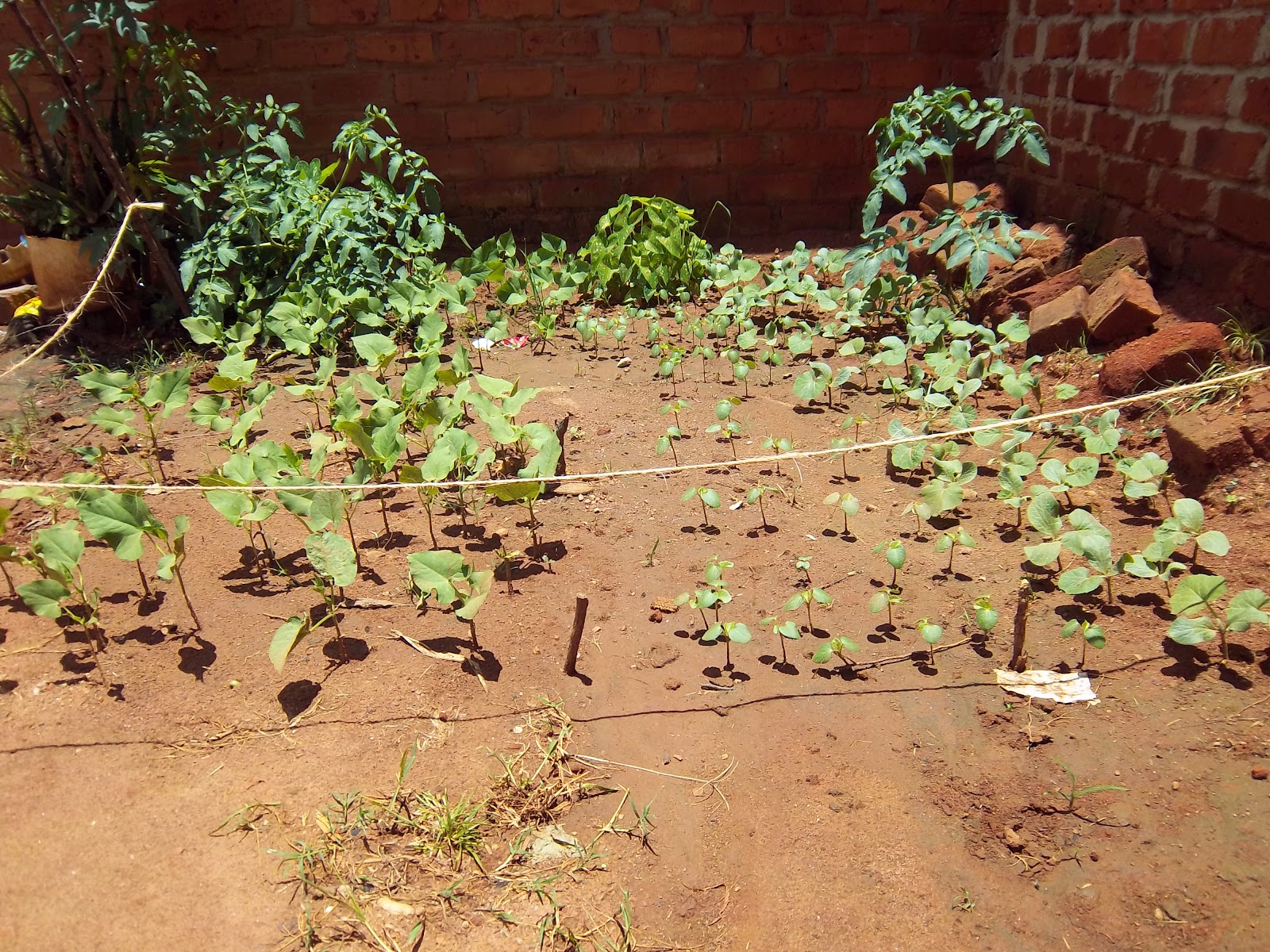 |
| bean, okra, and pumpkin patch |
 |
| Bean and corn patch |
 |
| Another corn patch |
 |
| Another pumpkin, corn, and okra patch |
